FOR LENDERS & PARTNERS
Partner with Levr.ai
OUR INVESTORS
Managing Partner
Managing Partner
General Partner
Join dozens of certified lenders and trusted partners


How it works
EASY PROCESS
Levr.ai makes it easy to apply for a small business loan
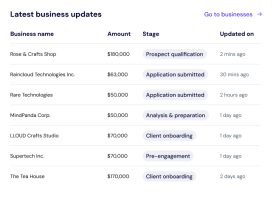
With its easy-to-use dashboard, Levr streamlines application prep. Invite decision makers, accountants and more to review documents and upload financials to get your loan funded—fast.
How Canadian Banking Rules Affect Online Casino Deposits and Withdrawals
Canada occupies an unusual position in the global online gambling landscape. Unlike the United Kingdom, which operates a centralized licensing authority through the Gambling Commission, or the United States, where federal and state laws create a patchwork of explicit prohibitions and permissions, Canada has historically governed gambling through a combination of federal criminal law and provincial jurisdiction. This division of authority has direct consequences for how money moves in and out of online casino accounts — and understanding those mechanics requires looking closely at the banking infrastructure that underpins every deposit and withdrawal a Canadian player makes.
The Regulatory Framework Behind Canadian Banking and Gambling Transactions
The foundational document governing gambling in Canada is the Criminal Code, specifically sections 201 through 210, which were amended in 1969 and again in 1985 to grant provinces the authority to conduct and manage gaming activities within their borders. What the Criminal Code does not do is explicitly prohibit individual Canadians from placing bets with offshore operators — a legal ambiguity that banks and payment processors have had to navigate for decades.
Canadian banks are federally chartered and regulated by the Office of the Superintendent of Financial Institutions (OSFI), which operates under the Bank Act of 1991. OSFI does not issue specific guidance prohibiting banks from processing gambling-related transactions. However, Canadian banks are also subject to the Proceeds of Crime (Money Laundering) and Terrorist Financing Act (PCMLTFA), administered by the Financial Transactions and Reports Analysis Centre of Canada (FINTRAC). Under PCMLTFA, financial entities must report suspicious transactions and large cash transactions above $10,000. Because gambling platforms can generate irregular, high-volume cash flows, banks apply heightened scrutiny to accounts that show patterns consistent with gambling activity.
In practice, this means that major Canadian banks — including Royal Bank of Canada, TD Bank, Scotiabank, CIBC, and BMO — have discretionary policies about processing transactions flagged with Merchant Category Codes (MCCs) associated with gambling. MCC 7995, which covers betting, casino gambling, and lottery tickets, is the code most frequently blocked or flagged by Canadian financial institutions. When a player attempts a credit card deposit at an online casino, the transaction is declined not because of a legal prohibition but because the bank’s internal risk policy treats MCC 7995 as a category requiring restriction or outright blocking.
How Deposit Methods Are Shaped by Banking Restrictions
The MCC blocking behavior of major Canadian banks has driven significant evolution in the payment methods available to online casino players. Interac, the domestic debit network operated cooperatively by Canadian financial institutions since 1984, became the dominant deposit method precisely because Interac e-Transfer transactions are not categorized under MCC 7995 in the same way that direct credit card charges are. An Interac e-Transfer moves funds from a player’s bank account to a casino’s payment processor through the standard email-based transfer infrastructure, and many banks process these without triggering the same automatic blocks that apply to credit card gambling transactions.
Prepaid solutions have also grown substantially in response to banking friction. Paysafecard, which entered the Canadian market in the early 2010s, allows players to purchase vouchers with cash and use the 16-digit PIN to fund casino accounts without any bank involvement. Similarly, Neosurf expanded its Canadian retail distribution network through convenience stores and pharmacies, targeting players who either cannot obtain traditional banking services or prefer not to link casino activity to their primary financial accounts.
The cryptocurrency shift is another direct consequence of banking policy. Between 2017 and 2023, several online platforms serving Canadian players integrated Bitcoin, Ethereum, and stablecoins like USDC as deposit and withdrawal options. Blockchain transactions bypass the traditional banking rails entirely, meaning no MCC code is assigned and no bank compliance system flags the payment. FINTRAC updated its guidance in 2019 and again in 2021 to bring virtual currency exchanges under PCMLTFA reporting requirements, but peer-to-peer crypto transfers to casino wallets remain outside the direct oversight of Canadian financial institutions.
Resources that catalogue payment compatibility across different platforms — such as Online Casinos for Canadian Players [YEA, where deposit method availability is mapped against provincial access — reflect how fragmented the payment landscape has become across different regions of the country.
Withdrawal Processing and the Asymmetry Problem
Deposits and withdrawals do not face identical regulatory treatment, and this asymmetry creates practical problems for Canadian players. When a player deposits using Interac e-Transfer, the transaction originates from a verified Canadian bank account, which satisfies the identity verification requirements that online platforms must meet under their own anti-money laundering (AML) obligations. Withdrawals, however, must return funds to a verified account — and this is where complications arise.
Many online casinos operating under Malta Gaming Authority (MGA) or Curaçao licensing require that withdrawals be processed back to the same payment method used for the deposit. If a player deposited via Interac but the casino’s banking partner has since changed its processing agreements, the withdrawal may be delayed or rerouted to a bank wire. Bank wire withdrawals to Canadian accounts typically take three to seven business days and may incur fees from both the sending institution and the receiving Canadian bank. RBC, for example, charges an incoming international wire fee of approximately $17 CAD, while TD charges $15 CAD for the same service as of 2024.
The situation becomes more complicated for players who used cryptocurrency deposits. Since crypto withdrawals return funds in digital assets rather than Canadian dollars, players must then convert through a registered exchange. Under FINTRAC’s 2021 guidance, Canadian crypto exchanges must collect Know Your Customer (KYC) documentation and report transactions above $10,000. A player withdrawing a significant sum from an online casino in Bitcoin and converting it to CAD through an exchange like Shakepay or Newton will trigger these reporting requirements, even if the underlying gambling activity was entirely legal under provincial law.
Processing times also vary significantly by method. Interac e-Transfer withdrawals, when available, typically complete within 24 to 48 hours. Credit card refunds — where banks permit them — can take five to ten business days. eWallet solutions like MuchBetter, which has specifically targeted the Canadian market since 2018, offer faster withdrawal processing because the funds move within the eWallet ecosystem before touching the banking system, reducing the number of compliance checkpoints the transaction must pass through.
Provincial Licensing and Its Effect on Payment Access
The 2021 passage of the Safe and Regulated Sports Betting Act (Bill C-218) and the subsequent launch of provincially operated single-event sports betting platforms changed the payment landscape in ways that are still developing. Ontario took the most significant step by launching iGaming Ontario in April 2022, creating a regulated private market in which operators must obtain a license from the Alcohol and Gaming Commission of Ontario (AGCO). Licensed Ontario operators are required to use payment processors that comply with provincial AML standards, which has encouraged banks to be more accommodating toward transactions with AGCO-licensed platforms.
The practical effect is that a player in Ontario using a provincially licensed platform faces fewer banking obstacles than a player in Alberta or Manitoba using an offshore platform. RBC and TD have reportedly processed Visa and Mastercard transactions for AGCO-licensed operators with lower decline rates than for unlicensed offshore platforms, though neither bank has publicly confirmed specific policy changes. This creates a two-tier payment environment within Canada itself: residents of provinces with active licensing frameworks have access to more conventional banking channels, while players in provinces without equivalent frameworks continue to rely on Interac, prepaid cards, and crypto.
British Columbia’s PlayNow platform, operated by BCLC since 2004, and Québec’s Espacejeux have long offered Interac and direct bank transfer options because their provincial operator status provides a compliance framework that banks recognize. The expansion of provincial licensing is gradually narrowing the payment method gap between regulated and unregulated platforms, but the process is uneven across the country and will likely remain so for several years as provinces move at different legislative speeds.
Canadian banking rules have not created a simple environment for online casino transactions, but they have shaped a payment ecosystem that is more diverse and technically sophisticated than in many comparable markets. The interplay between federal AML requirements, provincial gambling jurisdiction, and individual bank policies has pushed players and platforms toward solutions — Interac e-Transfer, prepaid vouchers, eWallets, and cryptocurrency — that might not have developed as quickly under a more permissive banking framework. As provincial licensing expands and FINTRAC continues refining its virtual currency guidance, the payment landscape will continue to shift, with banking access gradually improving for players on regulated platforms while offshore transactions remain subject to the same discretionary friction that has characterized the market for the past two decades.
MORE LOAN OPTIONS
Levr.ai harnesses the power of AI for custom loan options
Levr.ai uses AI to customize loan matches based on your businesses data. You can evaluate and decide what is the right loan option for you and when to engage with lending partners.
WHY PARTNER WITH LEVR.AI
Meet the right businesses
- Access quality leads
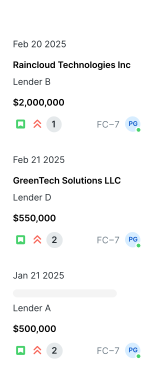
Our intelligent loans marketplace ensures SMBs are a good fit based on your lending criteria, for faster funding conversion rates on great applicants
- Efficient loan processing
Levr.ai handles preliminary due diligence on applicants, allowing you to quickly move to term sheet and loan offers
- Greater brand visibility
Joining our trusted network of certified lenders elevates your brand integrity and reaches more businesses looking for financing
- Partner satisfaction
Our team works hard to deliver excellent service to both our partners and SMBs on Levr.ai, building beneficial long-lasting partnerships
SUCCESS STORIES
Trusted by both small businesses and high-growth startups
“Levr.ai helped us discover options we didn’t know existed, ensured our documentation was complete, so we could be successful on our first try.”
“Levr.ai made getting our business loan a smooth and quick process. We have big goals for the next year, and Levr successfully helped us secure the right financing our business needs for continued growth.”
CEO & Co-founder
“The process from start to finish exceeded expectations. We had a bunch of loan options to consider thanks to Levr.ai, in tandem their ability to organize our documentation and application made all the difference in our fast approval.”
CEO & Co-founder
Frequently asked partner questions
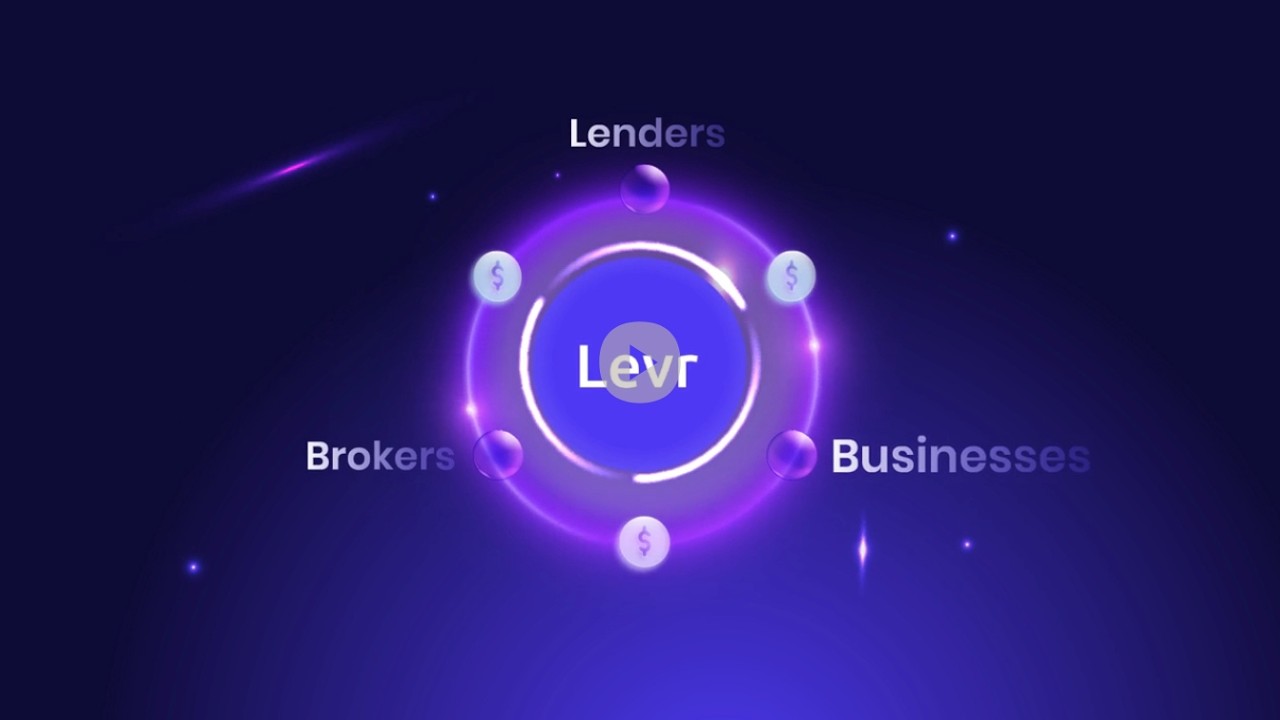
Levr.ai is a free, intelligent loans platform that allows a borrower to complete preliminary due diligence with dozens of lenders in less than 10-minutes. The platform is designed to make it easy and fast for borrowers to access funding while ensuring that lenders only engage with customers they’re interested in – saving everyone time and money while making it a more enjoyable experience.
Levr.ai functions as a software company and platform, bridging the gap between businesses and lenders in the market. It neither lends funds nor assumes any responsibility for evaluating loan risks. Instead, Levr.ai focuses on facilitating the presentation of data to lenders, empowering them to make lending decisions based on complete information.
Levr.ai connects borrowers to lenders in the market but does not function as a brokerage that “shops” a loan around for the best rate. Once a Levr.ai customer is connected with a lender, the customer and the lender engage with each other directly – we won’t get in the middle unless you ask for our support.
Using the information borrowers provide, Levr.ai uses artificial intelligence and machine learning to match them with the lender best suited to fulfil their needs. With the help of Levr.ai’s guides, tools, and templates, borrowers can streamline the creation of applications in a safe and secure environment. They can even invite their accountant, business partner, financial advisor etc. to their Levr.ai account to assist with applications and financial documentation required for a strong application.
Once a borrower has chosen a lender to proceed with, Levr.ai facilitates transfer of the file to the lender through the lender's preferred method.
We're excited to connect with all interested partners who are keen to help small businesses grow through better capital options. Our team will follow up with your request within 2-3 business days.
Once we determine there is a fit for both you and Levr.ai, your brand will be included on our intelligent loans marketplace, surfacing custom loan options to our users within 1-2 weeks.
Our main goal and mission is to serve the commercial debt financing needs of all businesses as best we can. Our priority is connecting borrowers with certified trusted lenders that would like its loan options surfaced on Levr.ai.
Not a lender, but still interested in a partnership with Levr.ai? Please reach out! We're open to partnerships that are good for our business users. We'd love to chat about your ideas and products.
Levr.ai is a venture-backed high-growth fintech business. Our priority is to build an app that drives value and helps to serve businesses in need of funding.
When Levr.ai matches business owners with lenders, and the right loan is funded a commission is paid by the lender. We are also able to offer a white glove service for clients that would like additional support to prepare their application which is priced based on each business's specific needs.
Levr.ai is a free intelligent loans platform that helps businesses gain better access to loan options. Not a free-trial for a few days or weeks free, Levr.ai is free—plain and simple.
Levr.ai provides easy to follow guides and templates to organize all your financial documents and application requirements. Currently we’re offering all businesses matched with loans access to a lender partner from the Levr.ai to ensure your application goes smoothly and can answer any questions you may have.
While we actively build the best loans experience on Levr.ai our development team as well as partnerships, marketing and co-founders are always available to learn more to build and scale value into the Levr.ai platform. Don’t forget, if you want to get help from someone you know—that is totally cool by us. It’s easy to invite your accountant, financial advisor, or even your mom to create a free Levr.ai account, they can collaborate with you all in one place.
We also have a pretty great Blog that discusses a lot of common topics and questions about getting funding for your business.
IN THE NEWS
Latest Press Releases
Press Release: Levr.ai secures $1 million of pre-seed funding to change the way businesses access and mange loans, building a better experience for both business owners and financial lenders.